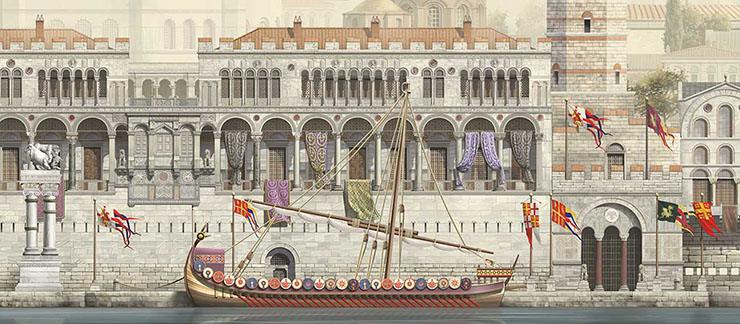
Boukoleon Palace stands along the historic southern shoreline of Istanbul, occupying a quiet yet strategically powerful position where imperial authority once met the waters of the Bosphorus.
Unlike more prominent monuments, this former Byzantine palace remains largely unnoticed, despite its deep connection to the political, ceremonial, and maritime life of Constantinople.
Overlooking one of the most important waterways in the ancient world, the palace served not merely as a residence, but as a visible expression of imperial dominance and strategic awareness.
Today, its fragmented remains still communicate the presence of a hidden imperial legacy shaped by centuries of power.
Boukoleon Palace as a Byzantine Imperial Residence
The origins of Boukoleon Palace trace back to the early Byzantine period, when Roman imperial traditions were gradually transforming into a distinctly Byzantine political identity.
Constructed initially during the fifth century, the palace complex developed alongside the administrative and ceremonial expansion of Constantinople.
Later emperors expanded the palace into a formal imperial residence that functioned as both a private retreat and a ceremonial stage.
Its location along the sea allowed emperors to maintain proximity to naval routes while reinforcing their presence along the Istanbul shoreline.
The Strategic Importance of the Bosphorus
The Bosphorus played a central role in Byzantine geopolitical strategy, acting as a corridor for trade, defense, and imperial communication between continents.
Positioning Boukoleon Palace directly along this waterway allowed emperors to control access while maintaining visual dominance over maritime traffic.
Sea access enabled ceremonial arrivals, rapid transportation, and discreet movement during periods of political uncertainty.
This combination of visibility and security reinforced the palace’s role within the broader defensive system of Constantinople.
Architectural Identity and Byzantine Design
The architectural character of Boukoleon Palace reflected a synthesis of Roman structural principles and evolving Byzantine architecture.
Grand terraces, marble façades, and sea-facing balconies projected authority toward the water while preserving controlled interior spaces.
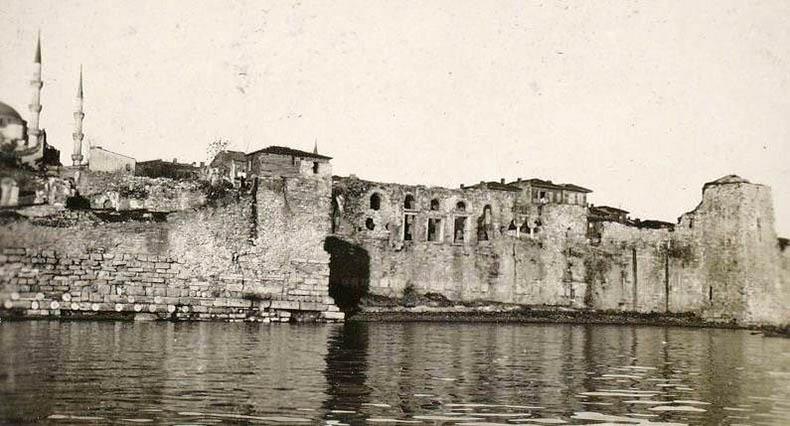
Although much of the structure has been lost, surviving arches, walls, and foundations reveal refined craftsmanship and careful spatial planning.
These remnants allow historians to reconstruct how function, ceremony, and comfort intersected within an imperial setting.
Imperial Life Along the Istanbul Shoreline
Within Boukoleon Palace, imperial life unfolded through a combination of diplomacy, governance, and ceremonial display.
Byzantine emperors hosted foreign envoys here, using the palace’s maritime setting to emphasize wealth, stability, and global reach.
Private chambers overlooking the sea provided respite from court pressures, while open terraces allowed rulers to observe naval activity along the Bosphorus.
This balance between public authority and private retreat defined daily life within the palace.
Cultural Memory and Historical Transitions
As a Byzantine palace, Boukoleon witnessed profound historical transitions, including the Latin occupation and the eventual Ottoman conquest of the city.
Each shift altered the palace’s function, gradually diminishing its role as an active imperial residence.
Despite decline, the site retained symbolic importance as a marker of Byzantine maritime power.
Its continued presence along the Istanbul shoreline preserves a tangible link to the city’s layered past.
Boukoleon Palace Today: Ruins and Rediscovery
Today, Boukoleon Palace survives primarily as a series of exposed ruins located behind modern infrastructure and rail lines.
Construction damage and long-term neglect have limited access, yet the remaining sea walls and architectural fragments continue to impress observers.
Growing public and academic interest has renewed discussions about preservation and interpretation.
As awareness increases, the palace’s role within Istanbul’s historical landscape gains overdue recognition.
Boukoleon Palace represents more than a forgotten structure, embodying a hidden imperial legacy shaped by geography, power, and architectural intention.
Its position overlooking the Bosphorus reveals how closely Byzantine authority aligned itself with the sea.
For visitors seeking deeper historical context beyond iconic landmarks, the palace offers a rare perspective on imperial life along the Istanbul shoreline.
Understanding this site transforms ruins into narrative, and scenery into historical meaning.
Wikipedia: Boukoleon Palace


